 |
|
|
||||||||||||||||
|
Last Updated |
||||||||||||||||||
|
||||||||||||||||||
















 |
||||||||||||||||||||||||||||||||||||||||||||||||||||||||||||||||||||||||
|
|
|
|
|||||||||||||||||||||||||||||||||||||||||||||||||||||||||||||||||||||
 ColorBurst Ganzfeld ColorBurst Ganzfeld
The ColorBurst is the hand-held mini-Ganzfeld stimulator of the Espion system. It produces a uniform field of light which is presented to the subject monocularly. The color and intensity of the light are precisely controlled in real time to create a range of visual stimuli, including flashes, flickers onset/offset and steady backgrounds. The ColorBurst fully supports all ISCEV Standard Ganzfeld tests, which come preprogrammed, but it is capable of creating a far wider range of stimuli than are encompassed by the standards. Two ColorBursts may also be combined to form a dual binocular stimulator with the addition of a dual controller box. Being a light easy manipulatable handheld device makes the ColorBurst ideal for using with children and infants, supine patients, or patients unable to sit at a regular full field style Ganzfeld for whatever reason.

The ColorBurst is an electronically controlled device with no troublesome moving parts. Its sphere diameter is 3.5" and the viewport diameter is 2.15". It can be held by either the patient or the examiner, or clamped to a rigid stand. Two buttons are included; one to start the acquisition and the other to abort the current run and delete the result. These buttons may be disabled in the software if required. Light output is generated by two rings of red, green and blue LEDs which are completely programmable for intensity, color and duration. It has three red fixation LEDs, one located in the center, and the other two 15 degrees either side which can be individually enabled or disabled and programmed for intensity. Finally it incorporates a dark adaptometer light source for dark adaptometry experiments. CustomizationOne standard customer request is to replace the red, green or blue with either IR, or UV LEDs. It is also possible, to change the type of blue LEDs to reduce the wavelength, or replace one of the colors with amber. Contact Diagnosys LLC directly for more information. |
||||||||||||||||||||||||||||||||||||||||||||||||||||||||||||||||||||||||


 |
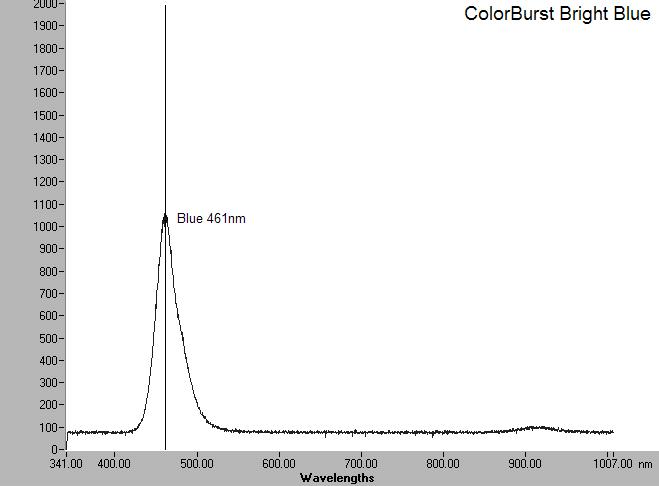
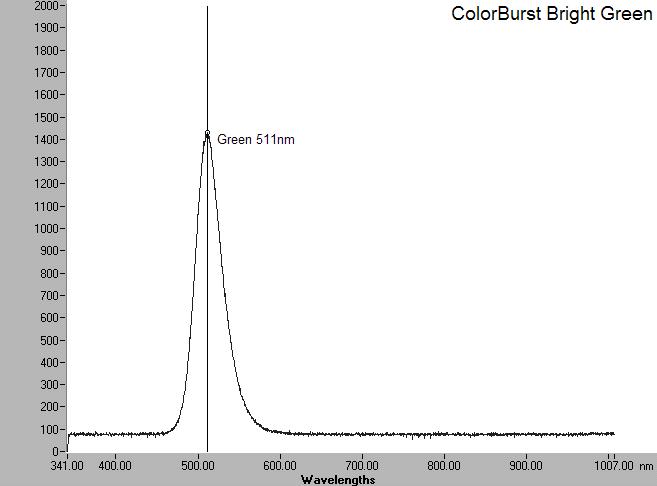
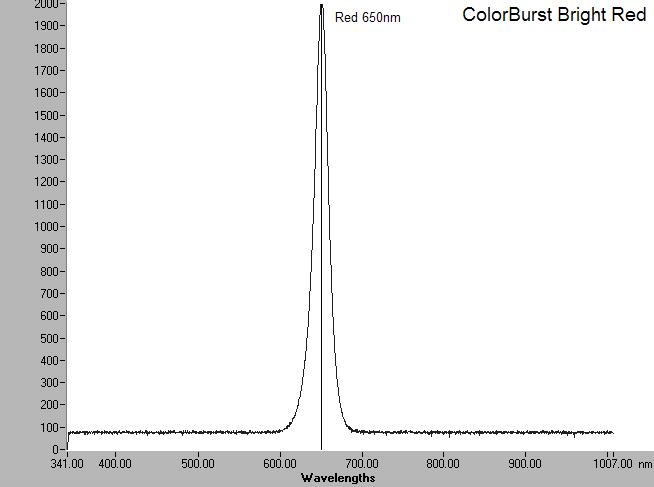
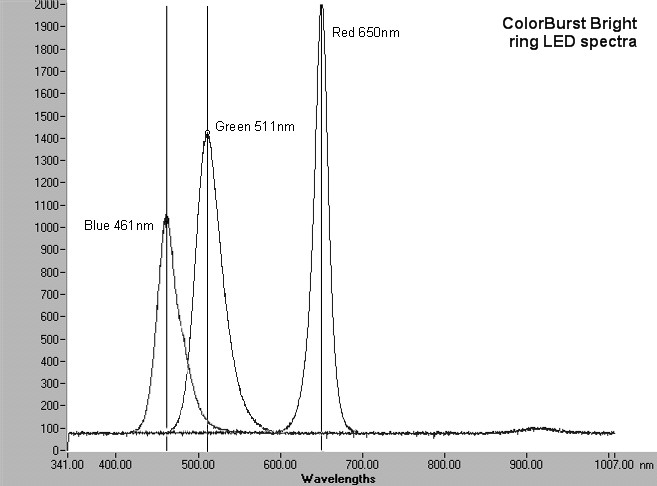
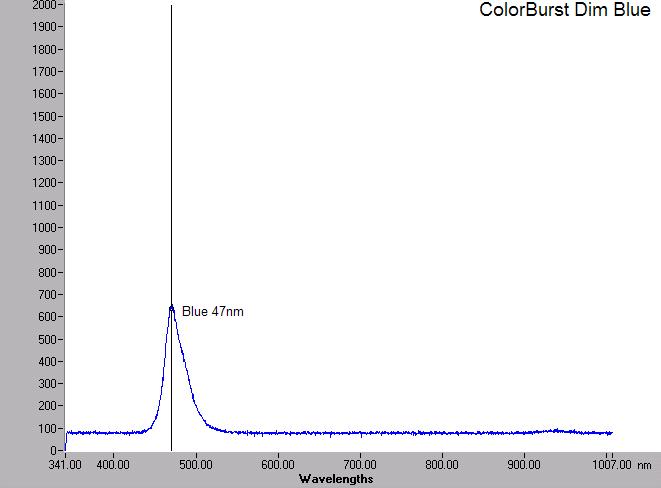
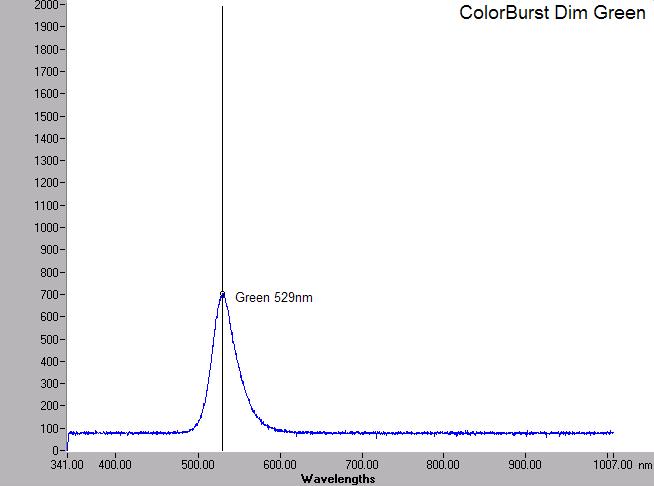
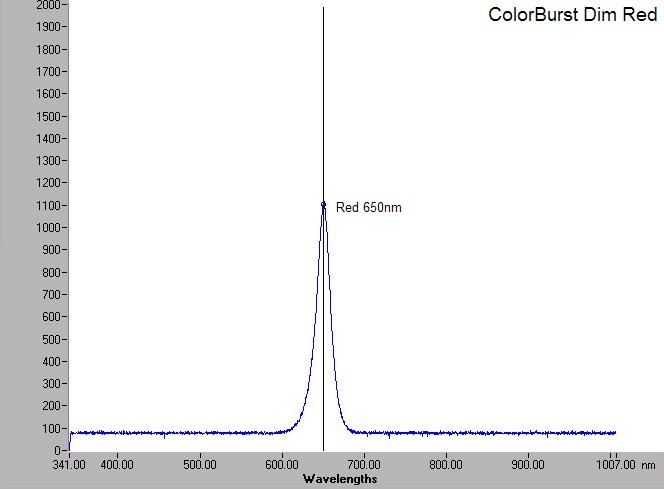
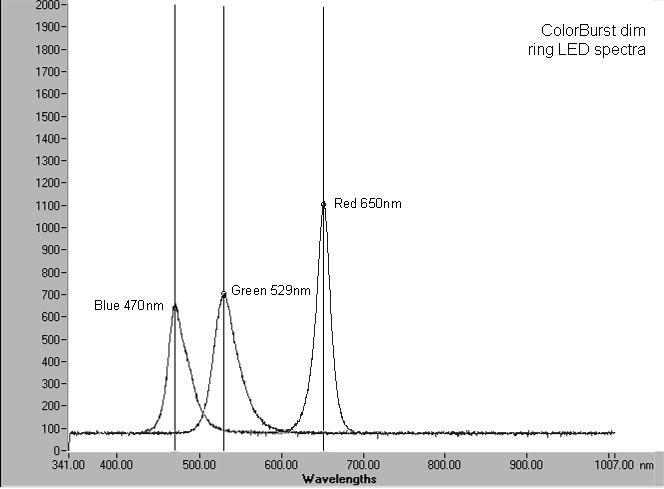
The system has two rings of around 200 ultra bright LEDs mounted around the inside of the opening consisting of red, green and blue which when combined together give the whole visible spectrum of colors. The luminance range covers nearly 107 orders of magnitude and which is divided up into three sub-ranges; bright, dim and low dim. Each sub-range is calibrated separately for color and luminance to ensure color changes are kept to a minimum when switching between them. LED control is provided by a highly accurate PWM (pulse width modulation) constant current system, rather than a variable voltage which ensures precise output with minimum color change. The system also auto calibrates every time it is used, to compensate for temperature effects. The ColorBurst can produce a steady background luminance of any color at up to 200 cd/m2, and of white up to 1000 cd/m2 easily surpassing the ISCEV standard of 34 cd/m2. The following table contains a set of typical LED spectral curves for a standard ColorBurst.
|
|
Due to customer demand, we have implemented in the software the ability to control two ColorBursts simultaneously that allows the pair to be used in either a binocular fashion or for two independent experiments. the pair can be run with identical outputs, or programmed with individual stimulus sequences e.g. beat frequencies for research. A dual system requires an external dual ColorBurst controller box, which provides the extra stimulator control hardware for the second ColorBurst and also provided an even higher resolution of control for the primary ColorBurst.
|
The software can control all aspects of the flash and background luminance intensity, color and duration with very precise resolution. Colors be any mixture of the three primaries selected by CIE coordinates, and intensities may be specified with a resolution of 1/64000 of full-scale. Luminance can be be specified in either scotopic or photopic units and flash intensities are entered in cd.s/m2 units rather than dB for absolute precision. Stimulus output may be programmed to be a single flash, multiple flashes, sinusoidal, exponential, ramp (for onset/offset responses), and a user defined arbitrary waveform.
User defined waveform files
User defined files enable you to specify the stimulus flash/background color, intensity, flash duration and trigger points on a ms by ms basis for either the ColorBurst or ColorDome Ganzfeld for arbitrary lengths of time. if you have a dual ColorDome or dual ColorBurst stimulator system, you can also define independent stimuli for each stimulator, an option not available from the main stimulus menu. Further you can define up to four user variables which allow parameters to be changed from the main menu without having to rewrite the waveform file. Finally, the parser includes a sophisticated expression evaluator allowing the inclusion of complex mathematical expressions and functions including sin, cos, exp etc. More information on writing these files can be found in the Download User Defined Files section.
|
Calibration of the LED system is fully supported by the system with an integrated calibration routine which when interfaced to the recommended Diagnosys photometer will automatically measure the maximum intensity and linearity of all three ranges for each color LED. As LEDs are very stable over time, re-calibration should not be required for some period of time and the color coordinates of the LEDs which are measured at time of manufacturer should not require further calibration. The system also includes a built in auto-calibration system which compensates for changes of room temperature on LED output for even more accuracy.
|
The ColorDome can be provided as a stand-alone stimulator with RS232 control for connection to existing 3rd party acquisition systems. The system allows the flash to be be triggered by an external device, or can provide an external trigger synchronized with the flash. Contact Diagnosys for more details.
Copyright © 2003, Diagnosys LLC
Suite 500, 175 Cabot Street, Lowell, MA 01854, USA
Phone: +1 (978) 458-1755 Fax +1 (978) 458 1600