|
|
[Ordering Information], [Download Files], [Features], [ISCEV Compatibility], [Design], [Xenon Flash Unit], [LED Unit], [Other Features], [Software Control], [Calibration],
[Stand-alone Option],[Custom Designs]
|
ColorDome Ganzfeld
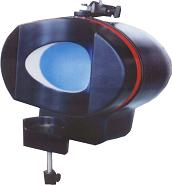 The new ColorDome full field Desktop Ganzfeld has taken two years to develop and contains many new and innovative features. Being all electronic control, it does not incorporate any mechanical parts for changing filters etc., but contains a mixture of colored LEDs and xenon flash tubes to give it an incredible luminance and color range. No other Ganzfeld currently available, comes anywhere close to providing the range, flexibility, compactness, and ease of use that the ColorDome brings to the market. The ColorDome can also be supplied as a stand-alone stimulator with full RS232/USB control for connection to existing 3rd party equipment. The new ColorDome full field Desktop Ganzfeld has taken two years to develop and contains many new and innovative features. Being all electronic control, it does not incorporate any mechanical parts for changing filters etc., but contains a mixture of colored LEDs and xenon flash tubes to give it an incredible luminance and color range. No other Ganzfeld currently available, comes anywhere close to providing the range, flexibility, compactness, and ease of use that the ColorDome brings to the market. The ColorDome can also be supplied as a stand-alone stimulator with full RS232/USB control for connection to existing 3rd party equipment.
Ordering Information
|
Part No
|
Description
|
|
D125
|
Desktop stimulator for Espion System. Includes table clamp
|
|
D169
|
Dual controller box for connecting two ColorDomes to the Espion
|
|
TBA
|
Stand-alone controller box
|
|
D164
|
Table top stand (Includes integral chin rest)
|
|
D181
|
Floor stand
|
|
D155
|
Trolley
|
|
Note: Please specify the length of cable when ordering. Standard length is 12ft (4m). Extra length will be charged on a per foot basis.
|
|
|
|
ColorDome with stand
|
ColorDome from side
|
|
 |
Download Files

|
Features
- Compact Size
- Weighs 7lb (3 Kg) without stand
- No mechanical parts for greater reliability
- All electronic control of color, luminance, and flash duration
- 9 red Fixation/EOG LEDs with adjustable intensity. that span 15-60 degrees horizontally
- Background and flash luminance created by Red, Green Blue, Amber LEDS with a flash luminance range from 25cd.s/m2 to around 0.000004cd.s/m2 (depends on color) and backgrounds in excess of 500cd/m2
- Integral Xenon flash tube for bright flashes with full electronic control of intensity and luminance range from above 2000cd.s/m2 down to below 0.009 cd.s/m2 in over 100,000 steps. Flash durations range automatically from 5us-2ms
- Integrated monochrome camera with infrared LEDs for luminance even in total darkness
- Full color modulation of background LEDs using definable wavetable files
- Built-in dark adaptometer hardware
- Xenon flash auto-calibrating system
- LED auto-calibrating system
- Flexible positioning with optional mounts
- Built in speaker for audio feedback during EOG and ERG tests
- Integral xenon filter holder
- Custom versions available
|
ISCEV Compatibility
|
ISCEV Test
|
Compatibility
|
Maximal Combined Response |
The ColorDome can produce a white flash at intensities of at least 1500 ISCEV standard flashes (1500SF) and is also able to create colored flashes at intensities of at least 10SF
|
Oscillatory Potentials |
Any single flash as described for the maximum combined response can be produced repeatedly for recording oscillatory potentials.
|
Single Flash Rod Response |
The ColorDome's scotopic mode creates dim stimuli especially for measuring rod-driven responses. It can produce short wavelength (blue - green) light at any intensity between 2SF and 2x10⁻⁷SF with luminance resolution of 1% or better and calibrated for scotopic vision according to the CIE V'l spectral response function. Additionally, the ColorDome can create dim white and colored flashes at up to 7 log units below 1SF with 1% or better resolution across the entire range, far surpassing the 2.5 log unit ISCEV standard.
|
Single Flash Cone Response |
Any single flash as described for the maximal combined response is delivered over a rod-suppressing background illumination.
The ISCEV standard recommends a flash to background ratio numerically equivalent to 3 cd.s/m2 (1SF) flash to 34 cd/m2 background. The ColorDomet can achieve this ratio at 1SF and across the entire range of white and photopic color mode flash strengths.
|
30Hz Flicker Response |
Flicker stimuli in white mode at luminance’s up to 100 cd/m2 or color mode at up to 200 cd/m2 can be created. The flicker rate can be increased from the ISCEV standard of 30Hz, up to 500Hz (LED only)
|
Off Response |
Steady light in white mode at luminance’s up to 500 cd/m2 or color mode at up to 100cd/m2 can be turned on and off, or ramped (exponential, ramp, sine) as required to measure off responses
|
Heterochromatic Flicker |
Arbitrary variations in color, luminance, or both can be specified at 1 millisecond intervals for over 1 second. Alternatively, color and intensity and an arbitrary duration may be defined per ms for up to 1000 and above different sequential presentations.
|
EOG |
LEDs span standard 30 degrees visual angle, with reversal frequency of 0.5Hz. The 9 ColorDome EOG LEDs span up to 60 degrees visual angle and have programmable reversal rate. The background lumination covers the full range of dilated and undilated pupil requirements reaching 500cd/m2
|
|
|
Design
The new ColorDome has radically broken away from the traditional desktop Ganzfeld bowl design to achieve a perfect balance of maneuverability, weight and luminance range to easily record all current and future ISCEV standard ERG/EOG tests. The whole design only weighs a few Kgs and is designed to connect to one of the standard photographic mount system using the common 1/4-20 thread mounting system. This means that it can be easily attached to any of the many commercially available photographic stands, e.g. Floor, Wall, ceiling, angle-poise and table top mounts. It can even be used on supine patients directly from the standard table top mount.
Due to customer requests, the Espion system will support two ColorDomes simultaneously connected. These can be programmed to produce identical stimuli, or independently controlled for greater flexibility. Finally the ColorDome can be programmed to remember the last stimuli (not flash settings) and reproduce these on power-up without computer intervention.
Customization
One customer request is to add an extra 8 xenon tubes, replacing the LED system, each with its own color filter holder. The software now supports ColorDomes with extra xenon tubes as standard.
|
Xenon Flash Unit
The Xenon flash unit is something we at Diagnosys are particularly proud of. Fully electronic, and using two flash tubes, it covers a vast range of luminance (approx. 106) and is highly linear over the entire range. It uses a novel feedback system which monitors the light output and terminates the flash at the appropriate time. This technique creates flash durations in the range 5us to 2ms and is really a built in auto calibration system which will produce the same light regardless of tube wear. However, like all systems certain compromises have to be made, and one of them is that it does not support 30Hz flicker at light levels above 1 standard flash (approx. 1.5cd.s/m2). Also, due to the nature of flash tubes and their discharge patterns, flash to flash variability is worse than that for LEDs and varies with flash intensity. The system does support “Bright flash” and “Double flash” experiments and even allows the user to create their own flash sequence.
LED Unit
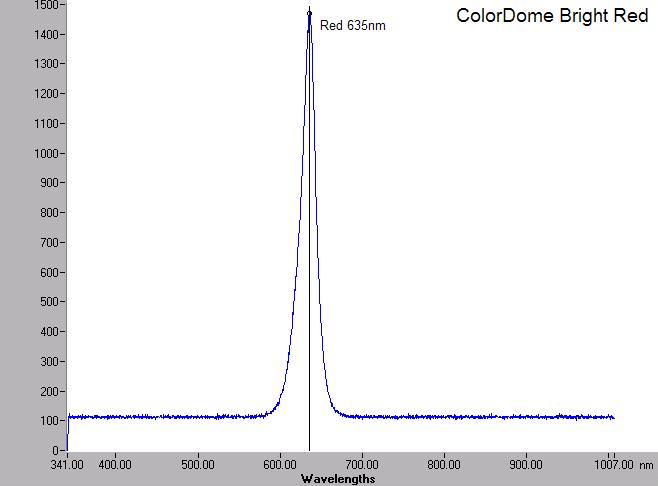
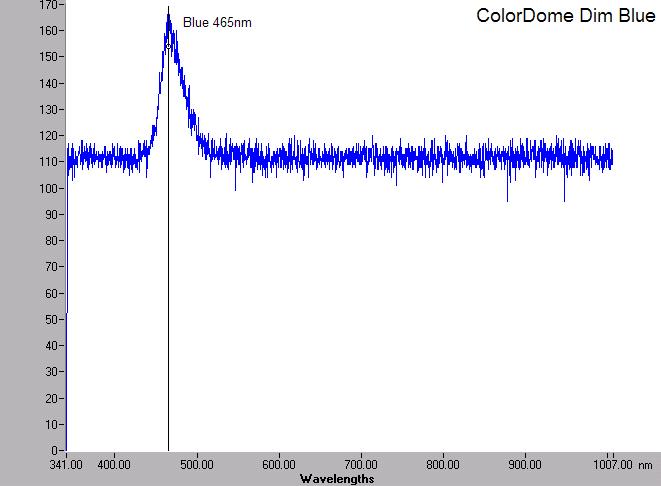
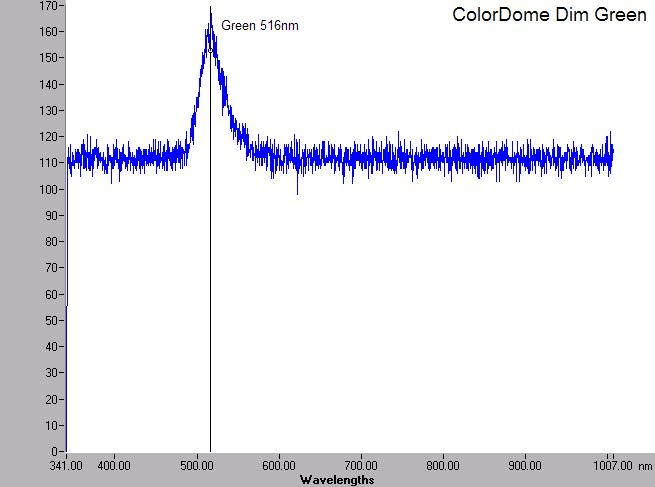
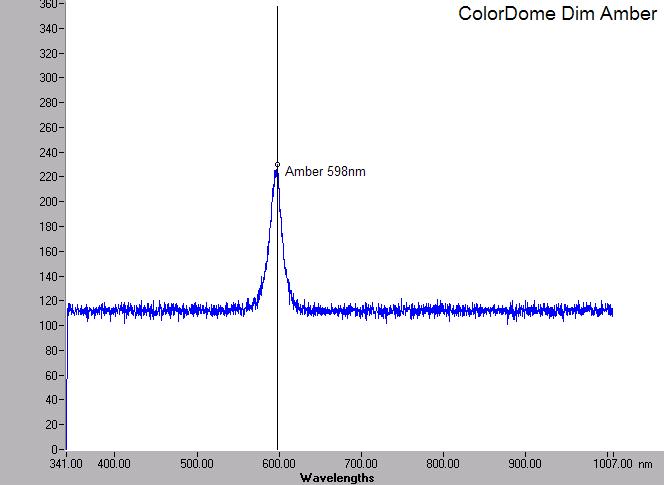
The system has two LED units, one mounted either side of the front port hole, which contains RED, GREEN, BLUE and AMBER LEDs. These can be adjusted for both duration and color electronically and cover a luminance range of approx. 107 producing flashes up to 25cd.s/m2, or steady state backgrounds of 500cd/m2. Control is provided by a constant current PWM circuit which keeps color changes with luminance intensity down to a minimum and provides a resolution of 64000 steps per ring. The circuit contains three rings of LEDs, a bright ring, a dim ring, and a low dim ring to achieve the vast luminance range and bright and dim rings are color calibrated. The LED spectral curves are listed below:
Other Features
Camera
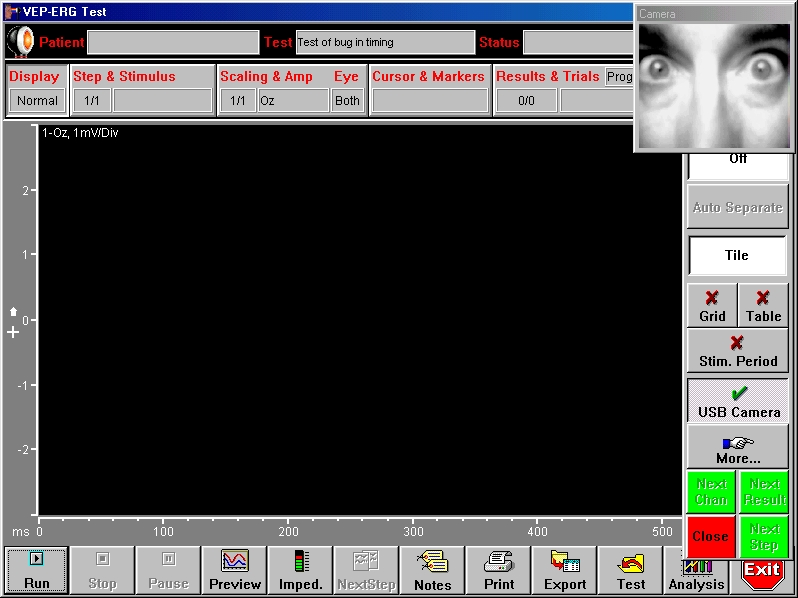
The desktop contains an infrared camera and filter with additional infrared LEDs to illuminate the patient’s eyes even during dark periods. The output of this camera may be viewed directly on the Espion screen via USB and also routed to a video monitor/recorder for real-time display of the patient’s eye movements including blinks.
Speaker
The built in speaker can be used to give an audible cue along with the LED cycle for EOG tests and also give an audible run up during ERG tests to help the patient prepare for the next flash.
Dark Adaptometry
Finally the desktop has a built-in dark adaptometer stimulator for dark adaptometry tests including patient button box interface. Software not yet available (Due for release end of 2003).
Software Control
The software can control all aspects of the flash and background luminance intensity, color and duration with very precise resolution. Colors be any mixture of the three primaries selected by CIE coordinates, and intensities may be specified with a resolution of 1/64000 of full-scale. Luminance can be be specified in either scotopic or photopic units and flash intensities are entered in cd.s/m2 units rather than dB for absolute precision. Stimulus output may be programmed to be a single flash, multiple flashes, sinusoidal, exponential, ramp (for onset/offset responses), and a user defined arbitrary waveform.
User defined waveform files
User defined files enable you to specify the stimulus flash/background color, intensity, flash duration and trigger points on a ms by ms basis for either the ColorBurst or ColorDome Ganzfeld for arbitrary lengths of time. if you have a dual ColorDome or dual ColorBurst stimulator system, you can also define independent stimuli for each stimulator, an option not available from the main stimulus menu. Further you can define up to four user variables which allow parameters to be changed from the main menu without having to rewrite the waveform file. Finally, the parser includes a sophisticated expression evaluator allowing the inclusion of complex mathematical expressions and functions including sin, cos, exp etc. More information on writing these files can be found in the Download User Defined Files section.
Calibration
LED
Calibration of the LED system is fully supported by the system with an integrated calibration routine which when interfaced to the recommended Diagnosys photometer will automatically measure the maximum intensity and linearity of all three ranges for each color LED. As LEDs are very stable over time, re-calibration should not be required for some period of time and the color coordinates of the LEDs which are measured at time of manufacturer should not require further calibration. The system also includes a built in auto-calibration system which compensates for changes of room temperature on LED output for even more accuracy.
Xenon
Calibration of the xenon system is performed every flash. The system integrates the light produced by the xenon tube in real-time and terminates it when the correct amount has been measured. This compensates for xenon output changes with time and improves linearity dramatically. You need of course to absolutely calibrate every so often, and this again can be done automatically by the system provided you have a suitable photometer.
Stand-alone Option
The ColorDome can be provided as a stand-alone stimulator with RS232 control for connection to existing 3rd party acquisition systems. The system allows the flash to be be triggered by an external device, or can provide an external trigger synchronized with the flash. Contact Diagnosys for more details.
Custom Designs
Diagnosys are very happy to provide custom versions of the ColorDome which can include adding infrared LEDs, UV LEDs, and colored XENON tubes. Contact the head office in the USA directly to discuss your requirements.
|